
Sustaining an age-friendly community initiative over many years can require as much dedication and determination as the initial work of starting one.
Part of our alliance’s mission is to support local leaders in building a foundation for age-friendly community projects that will withstand the test of time.
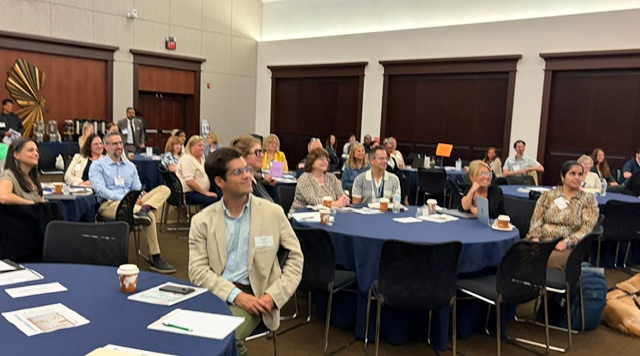
That’s why our alliance partnered on two events in September 2026 – one in-person and one virtual – that offered concrete examples and thoughtful strategizing on how community leaders can cement age-friendly principles and practices into their cities and towns.
The first, billed as “New Jersey’s Age-Friendly Summit”, was held on Sept. 16 in New Brunswick in partnership with AARP New Jersey and New Jersey Advocates for Aging Well (NJAAW). The second, a Sept. 25 virtual event organized by Rutgers University Hub for Aging Collaboration, was called “Exploring What Endures: The Long-Term Durability of Age-Friendly Community Initiatives and Their Impact.”
Both events came just a few months after the completion of New Jersey’s Age-Friendly Grants program, a 15-month-long program that seeded many new age-friendly projects and community initiatives across New Jersey.
“We hoped to offer those grant recipients and others engaged in age-friendly community building efforts some ideas and strategies for continuing that work in the longer-term,” said Dr. Cathy Rowe, executive director of NJAAW, which coordinates Age-Friendly NJ. “Many of the local leaders who regularly participate in our alliance are veterans of the grassroots work that must be done at the community level to achieve age-friendly progress. Many of us have also worked to build regional and state coalitions and sustained advocacy that helps support the work at the local level.”
The half-day summit held in New Brunswick featured a keynote presentation from Samar Jha, a housing expert and government affairs director for AARP, who outlined policies and strategies used throughout the country to promote livability and housing choices.
A series of interactive round-table discussions followed, led by veteran age-friendly leaders or other experts on six topics essential to age-friendly community planning: outdoor spaces and buildings; transportation; social participation, respect and social Inclusion; work and civic engagement; communication and information; and accessory dwelling units (ADUs).
Summit organizers intended those “peer-to-peer speed sharing” discussions as a way for participants to relay their community’s needs, challenges, successes and aspirations and receive seasoned advice and suggested strategies from the experts and their fellow attendees. Careful notes were taken of all discussions and then shared with participants.
“The goal was to spark new ideas and identify actionable strategies to move age-friendly efforts forward,” Rowe said. “Our alliance places a premium on being a platform for local leaders to learn from each other.”
The sustainability of age-friendly work was also the primary focus of the Sept. 25 virtual event, which featured a presentation on new research insights from Rutgers as well as moderated discussions with long-time age-friendly community leaders, including Sheila Brogan of Age-Friendly Ridgewood, Shannon Lyons of Generations for Garfield and Rowe, who formerly headed the SOMA, Two Towns for All Ages initiative.
A recording of the event can be viewed here and presentation slides are available here.
Julia Stoumbos, healthy aging program director for The Henry & Marilyn Taub Foundation, concluded the virtual event by describing how valuable it has been for community leaders to learn from each other and observe the ways that each has gone about their age-friendly processes differently, based on their individual community needs and characteristics.
“We’ve been figuring this out together,” Stoumbos said of the more than 11 years that founders of the alliance have been meeting with each other and collaborating on ways to advance age-friendly goals and strategies at the local, regional and statewide levels.
The supportive group learning environment that Age-Friendly NJ fosters can assist community leaders who are new to age-friendly work in identifying “changes that are easy and the ones that are harder to achieve and take time.”
And in the process, a statewide movement has taken shape.