
When generations come together through mentorship, everyone has something to gain.
That was the message of the 18-month-long age-friendly project undertaken by the Big Brothers Big Sisters of Coastal & Northern New Jersey (BBBSCNNJ). And it was also the outcome.
The nonprofit created a “Building Mentoring Capacity” initiative aimed at persuading more adults over age 55 to volunteer to provide guidance and companionship to youths in five counties: Hunterdon, Monmouth, Middlesex, Ocean and Somerset
The project addressed two significant challenges in this Central New Jersey region: the growing social isolation of older adults, particularly those who live alone, and the need for more positive role models for at-risk youth in underserved communities.
“Every generation has something valuable to offer. When we create opportunities for older adults to share their experience and young people to gain a trusted mentor, we’re doing more than addressing two important needs, we’re building the kind of connected community where everyone has the opportunity to thrive,” said William Salcedo, Executive Director of BBBSCNNJ.
Throughout the grant period, BBBSCNNJ partnered with local senior centers, community organizations, and faith-based groups to promote these mentoring opportunities and recruit a diverse group of volunteers. In all, 42 adults 55+ signed up to volunteer with youths who ranged in age from 6 to 18.
One of those mentorships started over a burger and fries at Shake Shack. Big Brother Mike and Little Brother Gavin, both of Ocean County, sparked a connection immediately. As their case manager went over match guidelines with the two, Gavin could barely contain his excitement and blurted out, “I hope you can take me golfing one day!” It turns out the interest was mutual, and Mike shared that he plays in a golf league and would be excited to share the sport with Gavin.
Their relationship has only grown over the past year. During another outing Mike introduced Gavin to bowling, which he enjoyed so much he ended up joining the bowling team at his school.
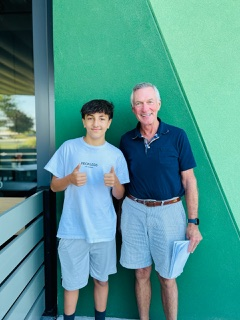
Gavin and Mike’s story is one of many of the relationships started through a BBBSCNNJ mentorship program that demonstrates the mutually beneficial outcome of connecting two generations.
Each match between a mentor and a youth is monitored and supported by a professional case manager, who helps ensure a healthy bond between the two.
“By blending targeted outreach, collaborative partnerships, and best-practice mentoring, we are building a sustainable model that elevates older adults as community leaders and ensures more children benefit from consistent, caring relationships,” Salcedo said.
Adult volunteers in the Community-Based Mentoring Program are expected to have at least two outings a month with their mentees, each lasting 2 to 4 hours. Activities can be as varied as walks in a park, visiting a museum, fishing, learning to play chess, baking a cake, going to the library, eating ice cream, or just talking about life.
Many of the volunteer mentors shared that they relished the connection with their mentee as well as the opportunity to share their experience and insights.
In surveys BBBSCNNJ conducted, some older adults interested in volunteering for the program expressed the need for a more flexible and accessible way for them to participate, particularly those with transportation or other mobility challenges.
The grant gave the organization the flexibility to explore program enhancements based on the needs that emerged during implementation. During the planning stage, transportation assistance was identified as a potential strategy for enabling more older adults to participate, but ultimately it was not needed. None of the older adult volunteers who moved through the enrollment process identified transportation as a barrier to participating in training or mentoring activities.
Instead, BBBSCNNJ found that scheduling flexibility and clear expectations about the mentoring commitment were more significant considerations. Those insights have informed the organization’s development of a hybrid mentoring model that combines virtual and in-person interactions, making the program even more accessible for future 55+ mentors.
“Some of life’s most valuable lessons are passed from one generation to the next through trusted relationships,” Salcedo shared. “Our goal is to make those connections possible for more people, because when we invest in each other, everyone benefits.”